
Cymatics — Expanded Field
The Human Form as a Resonant System
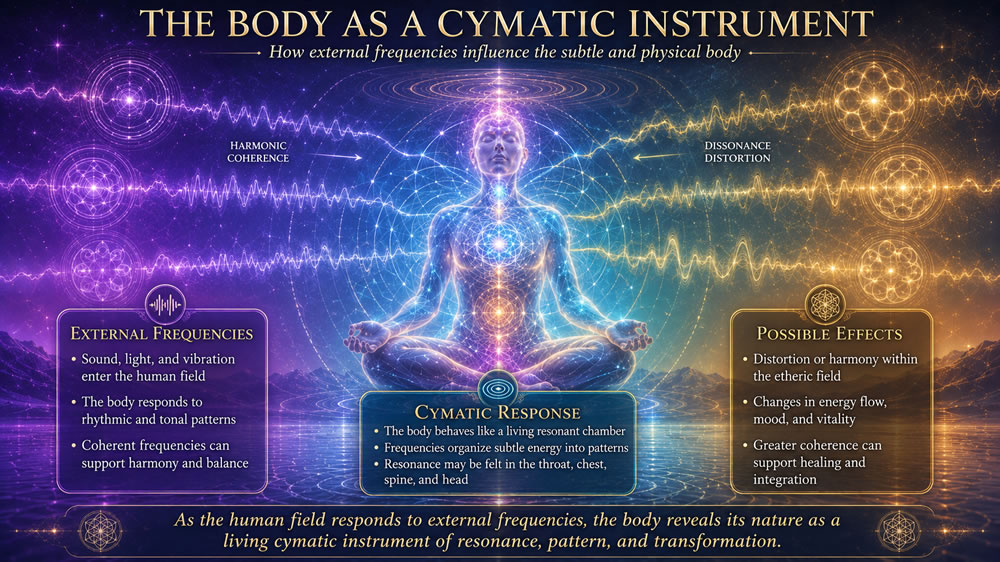
The human form is an intricate resonant system, responding to sound in ways that mirror the principles of cymatics. Just as sound waves create geometric patterns in sand, water, or other media, the human body, composed largely of water, crystalline structures in bones, and vibratory tissues, acts as a medium for these vibrations. When sound enters the body, whether through the ears, the skin, or bone conduction, it sets into motion subtle oscillations that propagate through cells, fluids, and membranes. Each part of the body has its own natural frequency, and sound energy can either harmonize with these frequencies, producing resonance and coherence, or disrupt them, leading to dissonance and imbalance.
At a cellular level, vibrations affect the molecular structures of proteins, membranes, and DNA. Research in sound medicine shows that cells are highly responsive to vibration, shifting in function and alignment according to the frequencies they are exposed to. Much like a cymatic plate organizing particles into harmonious forms, sound can support cellular coherence, aiding processes such as circulation, nervous system regulation, and immune function. Conversely, dissonant or chaotic sounds may create stress responses, disorganizing cellular communication. Thus, the human body can be seen as a living cymatic field where health corresponds to coherent vibrational patterns.
The nervous system, particularly, is a finely tuned cymatic receiver. Sound waves stimulate the auditory nerve and are translated into electrical impulses that influence brainwave activity, hormone release, and emotional states. Certain frequencies entrain the brain, guiding it into alpha, theta, or gamma states, which correspond to relaxation, meditation, or heightened awareness. Similarly, the autonomic nervous system responds to tone and resonance: harmonious sounds can slow the heart rate, deepen the breath, and shift the body into parasympathetic balance, while harsh or irregular sounds can trigger alertness or stress. The body, much like a cymatic surface, reorganizes its rhythm and flow in response to these tonal inputs.
On a more subtle plane, the human energy field, what is often called the aura or biofield, also displays cymatic-like patterns when influenced by sound. Ancient traditions and modern biofield research suggest that sound not only vibrates through matter but also through the subtler fields of consciousness surrounding and permeating the body. Mantras, chants, or musical tones can bring greater coherence to these fields, aligning them into symmetrical and luminous patterns, much like the geometric forms seen in cymatic experiments. In this sense, the human form is not merely a passive receiver of sound but a dynamic cymatic instrument, constantly reshaped by the vibrational environment, capable of attunement, healing, and transformation through the language of resonance.
Scientific Perspective
The human body is fundamentally vibrational in nature. Composed of nearly 70% water and containing crystalline structures in bones, cartilage, and even cell membranes, it is an ideal medium for transmitting sound. Sound enters the body not only through the ears but also through skin, bones, and fluids, where it generates oscillations much like the geometric forms seen in cymatic experiments with sand or water. Each organ and tissue has its own resonant frequency, and when exposed to sound, it can be brought into greater order or dissonance depending on the vibrational input.
At the cellular level, sound waves influence molecular processes. Research has shown that vibrations can alter gene expression, protein folding, and cell communication. Healthy cells tend to respond with coherence, organizing themselves into harmonious rhythms under beneficial sound, while disorganized patterns may correspond with stress or disease. This is very similar to how particles on a cymatic plate rearrange into structured patterns when exposed to harmonic frequencies or collapse into chaos under discordant ones.
The nervous system is particularly sensitive to sound. Auditory input translates into electrical impulses that directly affect brainwave activity, influencing mental states such as relaxation, focus, or heightened awareness. This process, known as brainwave entrainment, demonstrates how external vibration can guide internal rhythms. Additionally, sound impacts the autonomic nervous system: calming, harmonic tones can lower blood pressure, slow heart rate, and activate the parasympathetic system, while harsh, irregular noise may trigger stress responses. Thus, the body’s physiology literally reorganizes in response to sound.
Even on a macroscopic scale, the human form exhibits cymatic properties. The voice, for example, produces resonance throughout the skull, chest, and abdomen, creating standing waves that interact with organs and tissues. Modern therapeutic modalities, such as ultrasound, vibroacoustic therapy, and music therapy, utilize these principles to promote healing, reduce pain, and restore balance. In this sense, science increasingly supports the view that the body is a cymatic instrument, its health and function deeply shaped by resonance, rhythm, and tone.
Spiritual Perspective
From an esoteric standpoint, a human being is not just physical matter; we are also a field of subtle energy that reacts to vibration like water or sand in a cymatic experiment. Every sound carries intention and frequency, interacting with the aura, chakras, and etheric body. Harmonic sound can align these energy centers into balanced and radiant patterns, while dissonant vibrations distort or fragment the energetic field. Ancient traditions have taught that mantra, chanting, and sacred music serve as vibrational keys, unlocking harmony in the subtle body and raising consciousness.
The chakras can be viewed as cymatic centers, spinning vortices of energy that resonate with specific tones and frequencies. When a tone matches a chakra’s natural vibration, it boosts its rotation and radiance, bringing balance to the connected physical and psychological systems. On the other hand, discordant vibrations can weaken or distort these centers, leading to fatigue, imbalance, or emotional issues. Therefore, sound acts as both a diagnostic and healing tool, revealing an individual's energetic state through resonance.
In terms of consciousness, sound acts as a bridge between the limited personality and the infinite soul. Sacred sound practices, such as chanting “OM,” singing bowls, or overtone singing, are said to dissolve the fragmented patterns of the lower mind. This allows the unified note of the soul to resonate through the personality. As a result, the individual becomes a finely tuned instrument, harmonizing with the larger symphony of life. This supports the ancient belief that the universe is created and sustained through sound, the "Word" or primordial vibration.
Lastly, the human form functions as a cymatic instrument not just individually but also within collective fields. Group chanting, choir singing, or shared sound rituals generate resonant patterns that elevate both participants and the surrounding environment. These activities strengthen the subtle connections among humans, creating harmony that spreads outward into the world. From this perspective, every person is both a receiver and a transmitter of vibrational order, able to reshape matter and consciousness through the sacred practice of sound.
The Physical and Subtle Fields in Resonance
The human body is a living instrument of resonance, reacting to sound much like sand or water reacts on a cymatic plate. Physically, it consists of water, tissues, and crystalline structures in bones and cells that easily conduct vibration. Spiritually, it is interconnected with subtle energy fields, the aura, chakras, and etheric body, which also respond to frequency. When sound enters the human system through the ears, skin, or bones, it creates oscillations that travel through both matter and energy, forming patterns of order or disorder based on the harmony of the vibration. This shows that health and vitality can be viewed as states of vibrational coherence, while imbalance signifies dissonance in the body's cymatic field.
On a cellular level, sound deeply penetrates the structure of life. Scientific studies indicate that vibration can affect gene expression, protein folding, and communication between cells. Spiritually, this idea aligns with the thought that every cell has its own “note” within the body's broader symphony. Just as particles organize themselves into harmonious shapes under certain frequencies, cells and subtle energies align into coherent patterns when exposed to positive sound. Conversely, chaotic or discordant sounds can disrupt these patterns, causing stress responses in both biological and energetic fields. Thus, the cellular and the subtle reflect each other, both responding cymatically to tone.
The nervous system serves as another link between scientific and spiritual responses to sound. Neuroscience reveals that tones can synchronize brainwave activity, guiding the mind into relaxed, meditative, or heightened states. Esoteric teachings suggest that the same process activates higher consciousness, allowing the soul's note to influence the personality. In both scenarios, the body reorganizes itself under the influence of sound: breath slows, the heart finds a consistent rhythm, the mind achieves clarity, and the chakras brighten in response. Whether viewed as autonomic balance or energetic alignment, sound orchestrates the rhythms of both body and spirit.
Finally, the human voice illustrates this dual cymatic nature. Scientifically, vocal resonance vibrates the chest, skull, and abdomen, stimulating tissues and organs. Spiritually, chanting, mantras, and songs project vibrations through the aura, creating luminous patterns that align the individual with the greater life field. When groups chant or sing together, their combined resonance synchronizes their nervous systems and strengthens the collective subtle field, uplifting environments and communities. In this way, humans respond to sound and act as transmitters of vibrational order, an instrument that can tune itself and its world to harmony.
The Approach
The human being is both matter and energy, a physical body and a field of subtle vibrations, making it uniquely sensitive to the influence of sound. Just as cymatic experiments reveal how vibration organizes sand, water, or other materials into striking geometric patterns, the human form is constantly shaped by the tones and frequencies it encounters. Physically, the body is composed largely of water and resonant crystalline structures in bones and cellular frameworks, providing an ideal medium for transmitting sound. Spiritually, the body is interwoven with the aura, chakras, and etheric energy fields, each of which responds dynamically to vibration. Together, these levels of being reveal the human form as a living cymatic instrument, reorganizing itself according to the patterns of resonance that flow through it.
Cellular and Nervous-System Response
At the cellular level, the response to sound is both profound and precise. Scientific research shows that vibration can alter protein folding, stimulate circulation, and even affect gene expression. Cells communicate through electrical and vibratory signals, and sound can either harmonize or disrupt these pathways. In the spiritual view, every cell has a “note” it contributes to the overall symphony of the body, much like an orchestra in which each instrument plays its part. When exposed to harmonic frequencies, cells align into coherent rhythms, echoing the ordered patterns seen in cymatic plates. When exposed to chaotic sound, they may fall into dissonance, mirroring disease, fatigue, or imbalance. In both science and spirituality, coherence of vibration is equated with vitality and well-being.
The nervous system provides another window into this cymatic response. Modern neuroscience demonstrates that sound waves entering through the ear are translated into electrical impulses that guide brainwave activity. Specific frequencies can entrain the brain into alpha states of relaxation, theta states of meditation, or gamma states of heightened awareness. At the same time, esoteric teaching holds that sound opens gateways within consciousness itself, attuning the lower mind to the vibration of the soul. In both interpretations, sound acts as a bridge between physical functioning and expanded awareness, orchestrating shifts in rhythm and perception that ripple throughout the whole being.
The autonomic nervous system also demonstrates the dual impact of sound. Harmonic tones stimulate the parasympathetic branch, lowering heart rate, calming breath, and restoring balance to the body’s systems. Harsh or discordant sounds, by contrast, activate the sympathetic branch, heightening stress responses. In esoteric language, one might say that harmonious sound realigns the subtle currents of energy, strengthening chakras and stabilizing the etheric field, while disharmony fractures and agitates these patterns. Thus, whether measured by heart rate variability or seen as the radiance of the aura, the principle is the same: coherent sound restores balance, while chaotic sound disrupts it.
Chakras and the Human Voice
Chakras, the subtle energy centers described in spiritual traditions, can also be understood cymatically. Each chakra resonates to a range of frequencies, much like a spinning vortex tuned to a particular note. When a tone or chant corresponds with its vibration, the chakra strengthens, spins more freely, and radiates light. This effect not only uplifts energy but also reflects in the physical and emotional systems connected to that chakra. In a parallel way, science shows that resonant frequencies can stimulate glands, organs, and tissues associated with these centers. Both perspectives affirm that the body’s vitality depends upon the harmonious resonance of its centers, each contributing to the larger cymatic pattern of the whole.
The voice is a particularly powerful instrument for shaping these patterns. Scientifically, the vibrations of the voice resonate throughout the chest cavity, skull, and abdomen, generating standing waves that interact with tissues and organs. Spiritually, the voice projects into the subtle field, shaping luminous geometries that reflect intention and consciousness. Chanting sacred syllables such as OM, singing mantras, or using overtone harmonics can unify the body, mind, and spirit into coherent resonance. In this sense, the human being is not only acted upon by sound but also actively generates cymatic patterns that influence both inner and outer environments.
Collective Resonance and Synthesis
When groups engage in vocal sound together, through chanting, singing, or toning, the cymatic effects expand exponentially. Neuroscience shows that group singing synchronizes heartbeats and brainwave rhythms, creating a shared state of coherence. Spiritual traditions affirm that such collective sound creates radiant geometric fields that uplift entire environments and contribute to planetary healing. The body, in this context, becomes both a personal cymatic instrument and part of a vast symphony of collective resonance, shaping not only the individual but also the shared energetic field of humanity.
Ultimately, the human response to sound reveals a unifying principle: vibration organizes matter, energy, and consciousness alike. From the oscillations of cells to the radiance of the aura, from the entrainment of the brain to the harmonizing of communities, the human form reflects the same laws seen in cymatics, patterns of order arising from frequency and tone. Science offers us tools to measure these effects, while spirituality provides insight into their meaning and higher purpose. Together, they affirm that the human being is a resonant instrument of extraordinary sensitivity, capable of being tuned, healed, and elevated through sound, and of transmitting harmony into the wider world.