

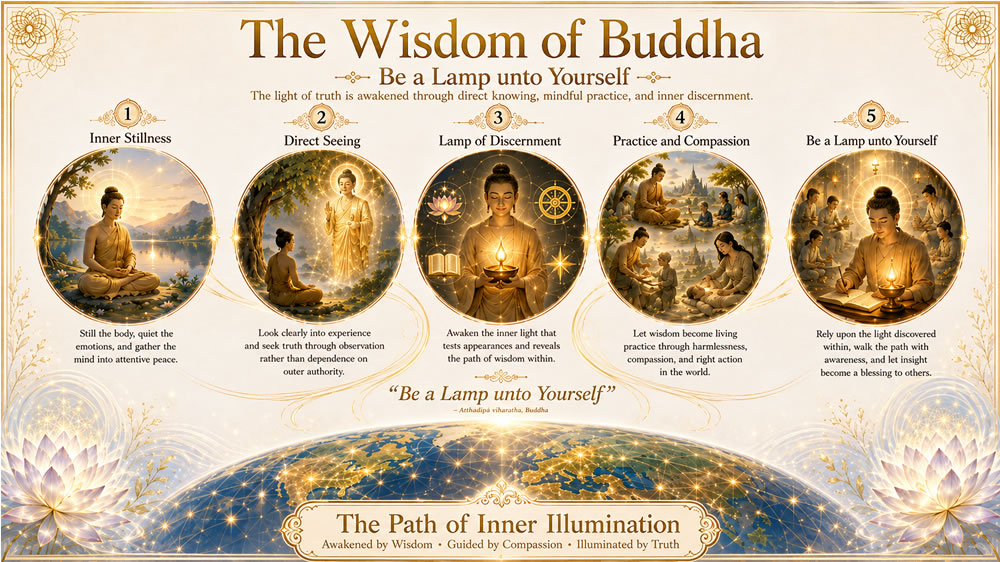
Be a Lamp Unto Oneself
The wisdom of the Buddha calls humanity inward, toward the quiet source of understanding that cannot be borrowed from another. The familiar teaching, “Be a lamp unto oneself,” expresses the responsibility of each person to cultivate awareness, discrimination, and inner steadiness. True wisdom is not gained merely by accepting beliefs, but through observation, reflection, disciplined living, and the direct recognition of truth within consciousness.
The Buddha’s path teaches that suffering is closely bound to attachment, craving, illusion, and mistaken identification. Liberation begins as these patterns are seen clearly rather than resisted blindly. Through mindful awareness, the individual learns to observe thought, emotion, desire, and reaction without becoming completely governed by them. In this clear seeing, space is created for understanding, compassion, and wiser action.
To become a lamp unto oneself does not imply isolation or rejection of guidance. Teachers, traditions, and sacred teachings may illuminate the path, yet each person must ultimately test truth through experience and insight. The lamp is the awakened faculty of discernment, the growing capacity to recognize what leads toward greater clarity, harmlessness, balance, and freedom from illusion.
Within the Ageless Wisdom, the Buddha stands as a great embodiment of Light and Wisdom, revealing the path by which consciousness may rise beyond the limitations of the lower mind and become receptive to deeper spiritual reality. His teaching encourages humanity to cultivate mental clarity, detachment, right perception, and compassionate understanding. Wisdom becomes possible when the mind grows quiet enough to perceive without distortion.
This inner illumination naturally changes the way one lives in the world. As attachment lessens, compassion deepens. As illusion gives way to clearer perception, judgment softens and responsibility increases. The awakened mind does not withdraw from humanity; rather, it becomes increasingly capable of serving without possessiveness, fear, or personal ambition.
The path of the Buddha therefore unites inner freedom with compassionate living. Meditation, mindfulness, ethical conduct, and right understanding are not ends in themselves, but means through which consciousness becomes more transparent to truth. The individual gradually learns to respond from awareness rather than reaction, from wisdom rather than assumption, and from compassion rather than separation.
The wisdom of Buddha remains a living invitation: seek truth with sincerity, observe the mind carefully, cultivate compassion, and allow inner illumination to guide the way forward. The lamp is not something placed into our hands from outside. It is kindled through conscious living and grows brighter as wisdom becomes embodied.
When the inner light is awakened, the path itself begins to appear. Hatred is never appeased by hatred. By non-hatred alone is hatred appeased. All that we are is the result of what we have thought. Be a lamp unto yourselves.
Reflections of the Buddha
Insight
Inspiration
For Reflection
Insight
Inspiration
For Reflection
Insight
Inspiration
For Reflection