
The Wesak Festival
The Festival of the Buddha — Light, Illumination, and Divine Purpose
Within the annual cycle of the Three Great Spiritual Festivals, Wesak stands at the center. Easter, observed at the Aries full moon, establishes the note of resurrection, renewed spiritual life, and the living Christ. Wesak follows at the Taurus full moon and brings the emphasis of illumination, wisdom, and divine purpose. The Festival of Goodwill then completes the sequence at Gemini, directing the accumulated spiritual energies toward humanity and the establishment of right human relations.
Within the Ageless Wisdom tradition, Wesak is regarded as the great Festival of the Buddha and the high point of the spiritual year. The Buddha is described as the spiritual intermediary between Shamballa, the highest planetary spiritual center, and the Spiritual Hierarchy. He is presented as the embodiment of Light, the expression of divine Wisdom, and an indicator of spiritual Purpose.
The Buddha and the Revelation of Light
The name Buddha means the Awakened One or Enlightened One. Through the life and teaching of Gautama Buddha, humanity received one of its clearest demonstrations of the path from desire and attachment toward liberation, illumination, and compassionate wisdom.
Traditional Buddhist observances of Vesak commemorate events associated with the Buddha's life, including his birth, enlightenment, and passing from physical existence. Within the esoteric tradition, Wesak is also understood as a present and living spiritual event, a recurring moment in which the Buddha continues to serve humanity and the planetary life.
The Buddha's contribution to human consciousness is profoundly related to the illumination of the mind. Through detachment, discrimination, right perception, and freedom from the distortions of desire, the mind becomes increasingly capable of reflecting reality without personal coloring. Illumination, in this sense, does not mean the accumulation of information. It is the emergence of clear seeing.It is the ability to perceive beyond appearance, conditioning, emotional reaction, and separative thought. As the mind becomes quiet and transparent, it begins to serve as an instrument through which the light of the Soul can reveal a larger field of truth.
Taurus and the Opening of the Eye
The Wesak Festival occurs at the full moon of Taurus. Within the esoteric presentation of the zodiac, Taurus carries the keynote:
“I see, and when the Eye is opened, all is Light.”
These words express the essential spiritual movement of Wesak. The ordinary eye perceives the outer world. The awakened inner eye perceives meaning, relationship, purpose, and unity. The opening of this spiritual vision does not remove us from life; rather, it allows us to see life more truthfully. Taurus contains a profound relationship between desire and illumination. Desire binds consciousness when it is directed exclusively toward possession, gratification, and attachment. Yet that same dynamic energy can be transformed into aspiration, spiritual determination, and eventually an unwavering orientation toward the greater Life. Thus the path of Taurus may be understood as a movement from desire toward aspiration, from aspiration toward illumination, and from illumination toward purposeful spiritual living. The light has always been present. The transformation occurs in the instrument that learns to see it.
Shamballa and Planetary Purpose
One of the distinguishing features of the Wesak teaching is its relationship to Shamballa. Within the Ageless Wisdom, Shamballa is described as the highest spiritual center of the planet, the center where the Purpose and Will of God are known. The Spiritual Hierarchy stands between Shamballa and humanity, receiving and interpreting the higher Purpose in forms that developing human consciousness can increasingly recognize and express.At Wesak, the Buddha is described as the great intermediary between Shamballa and the Hierarchy. Through Him, an aspect of divine Purpose is transmitted into the sphere of the Hierarchy, where the Christ receives and distributes the blessing on behalf of humanity.
Shamballa / Buddha / Christ and the Hierarchy / Humanity
This should not be understood merely as a hierarchy of authority. It describes a process of transmission and transformation. Spiritual energies of tremendous potency must be stepped down, qualified, interpreted, and distributed so that they can become useful within the consciousness of humanity. What originates as Purpose must eventually become enlightened understanding. What is received as spiritual Will must become loving action. What descends as Light must eventually illuminate human thought.
The Buddha and the Christ
Wesak reveals a particularly beautiful relationship between two of humanity's great spiritual Teachers: the Buddha and the Christ. Within the esoteric tradition, their work is understood as complementary. The Buddha embodies Wisdom and Light; the Christ embodies divine Love. Together they express the great principle of Love-Wisdom. At Easter, attention is directed primarily toward the living Christ and the Spiritual Hierarchy. At Wesak, the Buddha comes into the foreground as the transmitter of Light and Purpose. The Christ, however, remains central to the Festival because He is described as receiving the Buddha's blessing on behalf of the Hierarchy and humanity and then distributing that blessing into the world.
Thus Wesak becomes a symbol of East and West meeting within one spiritual purpose. The Buddha and the Christ are not presented as competing religious figures. They stand as two great expressions of one divine Reality, Wisdom and Love working together for the liberation and awakening of humanity. Where wisdom without love may become distant, and love without wisdom may become unfocused, the union of the two produces enlightened compassion. This synthesis lies at the heart of the Wesak experience.
The Wesak Blessing
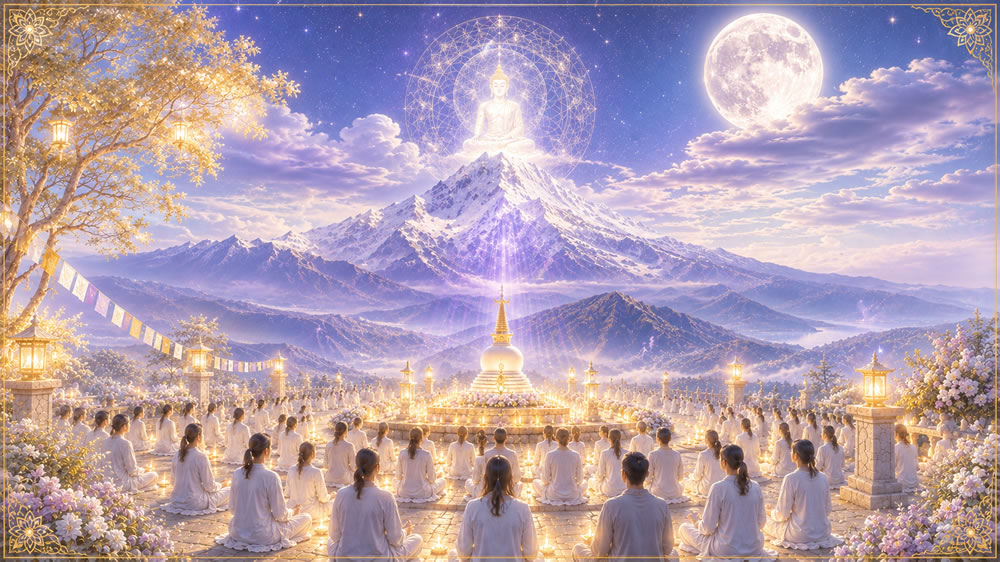
An ancient tradition preserved within the esoteric presentation describes a sacred ceremony occurring annually at the Taurus full moon in a remote Himalayan valley. According to this teaching, members of the Spiritual Hierarchy gather in preparation. The Christ stands at the center of the assembly, surrounded by the Masters and those spiritually aligned with the work of the Hierarchy. At the exact time of the full moon, the Buddha is said to appear and bestow a blessing. The Christ receives this blessing on behalf of humanity and directs it outward through the Hierarchy and into the human family.
The ceremony is therefore presented not simply as an act of spiritual devotion but as an event of transmission and distribution. Whether this account is approached as literal spiritual reality, symbolic teaching, or sacred myth, its central meaning remains powerful. Higher spiritual realization is not intended to remain isolated within those who attain it. Light is received so that it may be shared. Wisdom is realized so that it may become compassionate action. Blessing is received so that it may circulate throughout the whole. The true measure of spiritual reception is therefore distribution.
The Forces of Enlightenment
Just as the Easter period is associated in the Ageless Wisdom with the Forces of Restoration, Wesak is especially associated with the Forces of Enlightenment. These Forces are described as carrying energies related to divine understanding and as strengthening those who seek to serve the human family. They are associated particularly with illumination of the human mind and with the emergence of ideas capable of contributing to a more enlightened civilization. The importance of this idea becomes evident when we recognize that humanity builds civilization through thought.
Ideas precede institutions.
Values precede systems.
Vision precedes reconstruction.
When new spiritual principles begin to enter human consciousness, they often first appear as ideas, sometimes quietly, sometimes through individuals or groups who perceive possibilities that have not yet become widely recognized. The work of enlightenment therefore involves more than mystical revelation. It includes education, communication, science, philosophy, the arts, human relations, and every field through which clearer understanding can enter collective consciousness. The Forces of Enlightenment are meaningful only when light becomes usable.
From Illumination to Responsibility
The light associated with Wesak carries responsibility. To see more clearly is also to become more accountable for what one sees. Illumination reveals relationships that were previously hidden. It exposes the consequences of choices. It reveals the interdependence of people, nations, kingdoms of nature, and the planetary life itself.As consciousness expands, the boundaries of responsibility expand with it.
Therefore, genuine enlightenment cannot remain purely contemplative. It must gradually influence how we think, speak, create, relate, organize, and serve. The illuminated mind becomes valuable when it participates in the healing of separation. Wisdom becomes meaningful when it guides action. Spiritual vision becomes useful when it helps humanity recognize a greater possibility. Wesak therefore contains both revelation and obligation.
Preparation, Reception, Safeguarding, and Distribution
An important element of the traditional Wesak discipline is the five-day period surrounding the Festival. The two days preceding the full moon are regarded as days of preparation and dedication. The day of the Festival itself is a period of reception and safeguarding, during which participants seek to remain steady, receptive, and inwardly aligned. The two days following the Festival are associated with distribution.
Preparation — the instrument is clarified and consciously aligned.
Reception — consciousness becomes open to spiritual impression.
Safeguarding — the received energy is held with steadiness and without premature dissipation.
Distribution — what has been received is directed outward through thought, relationship, goodwill, and service.
This pattern has value far beyond Wesak itself. It describes a fundamental principle of spiritual work. Every genuine impression requires preparation. Every contact requires steadiness. Every spiritual realization ultimately calls for expression. Without distribution, spiritual energy can become self-centered. Without safeguarding, it may be dissipated. Without preparation, reception may become distorted by personal expectation. Wesak therefore teaches not merely how to receive light, but how to become responsible for it.
Group Consciousness and Service
The Festival is fundamentally a group event. The emphasis is not upon personal vision, psychic phenomena, unusual experiences, or individual spiritual attainment. The participant seeks instead to become part of a larger field of invocation and service. The group approaches not as a collection of separate personalities seeking individual blessing, but as a unified field of consciousness attempting to become useful to the greater planetary life. Personal concerns are temporarily set aside. The mind becomes steady. The heart becomes inclusive. Attention turns toward humanity and its need. Through this group orientation, meditation becomes a form of service rather than simply an inward spiritual exercise. The individual learns to function as part of a larger organism, a conscious point within a network through which light, love, and spiritual purpose may circulate. The goal is not spiritual possession. It is spiritual availability.
The High Point of the Spiritual Year
Wesak has traditionally been described within the Ageless Wisdom as the high-water mark of spiritual blessing during the annual cycle. The Taurus full moon is treated as an especially concentrated period of spiritual approach and human invocation.
This does not diminish the significance of Easter or the Festival of Goodwill. Rather, each Festival plays a distinct role within one unfolding process.
Easter — Life awakens.
Wesak — Light reveals.
Goodwill — Humanity distributes.
Easter sounds the note of spiritual Life and resurrection. Wesak brings Light, Wisdom, and Purpose into intensified relationship with the Hierarchy and humanity. The Festival of Goodwill then turns these energies increasingly toward human expression through goodwill, unity, and right relationship.
Wesak therefore occupies the central point within the Three Festivals, the moment of profound reception before the energies turn increasingly toward distribution.
Standing Within the Light
To approach Wesak consciously is to approach the mystery of illumination.
What within us prevents clear seeing?
What desires, assumptions, attachments, or inherited patterns cloud perception?
Can the mind become sufficiently quiet to receive a greater impression?
Can we hold spiritual energy without immediately coloring it with personal interpretation?
Can we receive light not for ourselves alone, but for the benefit of the whole?
The Buddha demonstrated that awakening requires clarity, detachment, compassion, and disciplined attention. The Christ demonstrated that spiritual realization must ultimately become Love in expression.
At Wesak these two great streams meet.
Light and Love.
Wisdom and Compassion.
Purpose and Service.
The Festival reminds us that humanity does not stand outside the great spiritual Life. We participate within it. Through meditation, intelligent thought, right relationship, and selfless service, human consciousness can become increasingly responsive to the greater Purpose seeking expression through the world. At Wesak we therefore turn toward the Light, not to escape the world, but to see it more clearly. We seek illumination not as an end in itself, but as preparation for service. We stand with humanity, with the Spiritual Hierarchy, with the Christ, and symbolically with the Buddha, seeking to become receptive to that greater current of spiritual Purpose which moves from the highest center of planetary Life toward the waiting world.
And when the Eye is opened, all is Light.